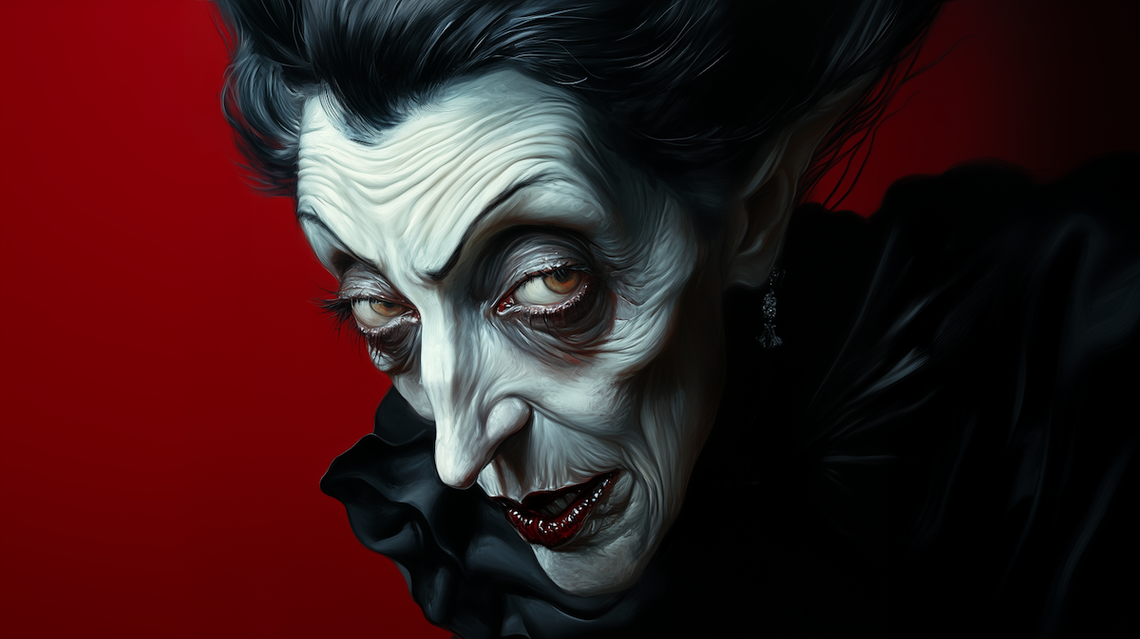
When Monsters Choose Beauty over Blood
Hollywood has always had a complicated relationship with aging. We freeze stars in amber through film, create immortality through celluloid, and pretend that beauty exists outside of time. But what if it actually could?
Hollywood Vamp isn't interested in the usual vampire tropes—the coffins, the stakes, the garlic. It asks a more uncomfortable question: what if eternal life looked exactly like success? What if immortality wore couture and lived in mansions and collected art and never, ever had to worry about relevance fading?
The Van Vamps aren't monsters hiding from society. They ARE society; at least, a certain echelon of it. The kind that appears in magazines from years ago looking exactly as they do today, explained away by "good genes" and "excellent skincare."
They've perfected something Hollywood has chased for a century: the ability to remain perpetually relevant, perpetually beautiful, perpetually desired.
What makes them terrifying isn't fangs, it's patience.
They don't hunt in dark alleys. They invite you in. They offer you the thing every creative desperately wants—access, visibility, the chance to be part of something legendary. The photographer in Hollywood Vamp isn't attacked; he's commissioned. He walks into the mansion willingly, camera in hand, imagining how the assignment will transform his career.
The real horror is the realization that you were never the photographer at all. You were always the subject.
Hollywood Vamp explores a particular kind of seduction that happens in creative industries—the promise that proximity to greatness will make you great by association. That if you can just get inside exclusive spaces, photograph those elusive figures, capture that impossible beauty, somehow it will transfer to you. Somehow you'll become part of the legend.
Clearly, the Van Vamps have been exploiting this for generations. Every decade brings new admirers, new artists, new ambitious creatives who hear the whispers and can't resist trying to get close. Some become portraits on the walls; others become cautionary tales. A lucky few, very few, escape to tell stories no one quite believes.
In our current moment, when creative industries are built on manufactured aspiration and curated perfection, when "influence" is currency and access is everything, the Van Vamps look less like fantasy and more like metaphor. They are the dark side of parasocial relationships, where the beautiful and powerful consume the ambitious and hopeful and where every interaction is transactional even when it feels intimate.
Despite the imagery, Hollywood Vamp suggests the real monsters aren't only the ones with fangs. They're also the ones who've learned to make exploitation look like opportunity. Who've perfected the art of making their victims feel grateful for the privilege of being consumed.
The photographer escapes. But now he sees that beauty and glamour can kill, and that sometimes the price of getting close to greatness is discovering it was never great at all. Just old, hungry and very, very good at making you believe otherwise.